
In recent years, the terms FUE and DHI have become increasingly common in discussions about hair transplant surgery.
In some countries, DHI is promoted as a “new” or “more advanced” technique compared to traditional methods.
However, from a technical standpoint, the distinction between FUE and DHI is often misunderstood.
In reality, DHI does not represent an entirely new category of surgery. Rather, it refers to a specific implantation method within the overall hair transplant procedure.
In countries such as South Korea, techniques similar to what is now marketed as DHI have long been performed as part of standard clinical practice.
This article clarifies the difference between FUE and DHI, explains their technical foundations, and explores how these methods evolved.
Affordable. Advanced. Beautifully designed. Hair transplants in Korea.
Restore Your Confidence in Korea — Trusted by Over 3,000 Hair Transplant Patients Every Year.
From clinic coordination and interpretation to accommodation, airport transfers, and on-site care, we provide seamless end-to-end support throughout your entire journey.
What Is FUE?
FUE, or Follicular Unit Extraction, refers to the method used to harvest individual hair follicles from the donor area.
Using a small punch instrument, follicular units are extracted one by one and then transplanted into the recipient area.
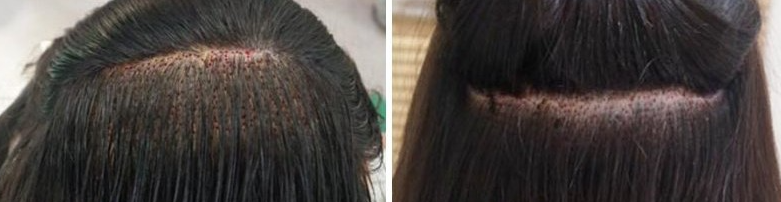
In traditional FUE procedures, the surgeon first creates small incisions or channels in the recipient area. The harvested grafts are then inserted into these pre-made sites.
Therefore, FUE describes the extraction process, not the implantation technique itself.
What Is DHI?
DHI, or Direct Hair Implantation, refers to a method of placing harvested follicles directly into the scalp using a specialized implanter device.
Instead of creating recipient channels in advance, incision and implantation occur simultaneously during graft placement.
Key characteristics of DHI include:
- Individual follicle extraction, typically using the FUE method
- Use of a specialized implanter pen
- Simultaneous incision and implantation
It is important to note that even in DHI procedures, follicle extraction is usually performed using FUE techniques.
Slit Method vs DHI: What Is the Real Difference?
The main difference lies in when and how the recipient site is created.


In the slit method, incisions are made first and grafts are inserted afterward.
In DHI, incision and implantation occur simultaneously using an implanter device.
Both approaches can achieve excellent results when performed by experienced surgeons.
The outcome depends more on surgical precision and planning than on the label of the method itself.
FUE and DHI Are Not Opposing Techniques
Many patients believe they must choose between FUE and DHI as if they are two completely different procedures.
Strictly speaking, this comparison is not technically accurate.
FUE refers to the method of follicle extraction, while DHI refers to the method of follicle implantation.
These terms describe different stages of the surgery rather than competing surgical systems.
A hair transplant procedure consists of two main stages:
- Harvesting hair follicles
- Implanting hair follicles
For harvesting, FUE is widely used. For implantation, two main approaches exist:
- Creating recipient channels in advance, often called the slit or channel method
- Using an implanter device for direct implantation, commonly referred to as DHI
Therefore, the more accurate comparison is between the slit method and the DHI implantation method, not between FUE and DHI.
In most cases, procedures labeled as DHI still rely on FUE for the extraction phase.
Is DHI Truly a “New” Innovation?
In certain medical tourism markets, DHI has been presented as a groundbreaking advancement in hair transplantation.
However, the concept of using implanter devices for direct follicle placement has existed for many years. It is not a completely new invention.
In South Korea, for example, implantation techniques using implanter tools were introduced and standardized early on, particularly as clinics emphasized natural hairline design, high-density transplantation, and precise angle control.
What is now marketed in some countries as a “new DHI technique” had already been incorporated into routine surgical practice in Korea.
The Development of Technique in South Korea
South Korea has long been recognized for innovation in cosmetic and reconstructive medicine.
In the field of hair transplantation, the focus has extended beyond simply moving hair follicles.
.jpg)
Korean clinics have emphasized:
- Natural and individualized hairline design
- Precise control of implantation angle and direction
- High-density packing strategies
- Minimization of graft damage and handling time
Within this evolution, direct implantation techniques now associated with DHI became part of standard surgical protocols rather than being treated as a separate revolutionary category.
Conclusion
The difference between FUE and DHI is not a matter of superiority, but of surgical process.
FUE describes how follicles are harvested, while DHI describes how they are implanted.
Although DHI is sometimes marketed as a new technology, direct implantation using implanter devices has been practiced for years in advanced hair transplant centers, including those in South Korea.
Ultimately, the name of the technique is less important than the surgeon’s expertise, design capability, and post-operative management system.
Understanding the technical substance behind these terms allows patients to make informed decisions based on surgical quality rather than marketing language.
Affordable. Advanced. Beautifully designed. Hair transplants in Korea.
Solve your hair loss concerns at one of Korea’s leading clinics, trusted with over 3,000 procedures each year. From interpretation and on-site assistance to accommodation and transfers, we support you every step of the way.
Tag List
Hair Transplant Column





「美容植毛」
コストパフォーマンスが高い
韓国の美しい自毛植毛