

There are two ways to take grafts from the donor area at the back and sides of the head: follicular unit excision (FUE) and follicular unit transplantation (FUT, also called strip surgery). Neither is better for everyone.
This guide compares how they work, the marks they leave and what a doctor considers when recommending one.
| FUE | FUT | |
|---|---|---|
| How grafts are taken | One by one with a small punch | A thin strip of scalp is removed and divided under magnification |
| Donor marks | Many small dot-like marks | One fine line, usually hidden under the hair |
| Shaving | Usually some trimming of the donor area; line-cut and non-shaven options exist | Hair above the strip covers it; little shaving |
| Early recovery | Small wounds heal over days | The closed incision takes longer to settle and may feel tight |
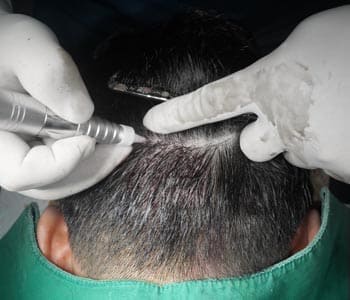
In FUE, each follicular unit is removed individually and later placed in the recipient area. The donor area is usually trimmed short so the doctor can see the hair direction. Line-cut and non-shaven FUE also use follicular unit excision. The donor area is shaved in narrow bands or left largely unshaved, which usually takes longer and suits smaller sessions.
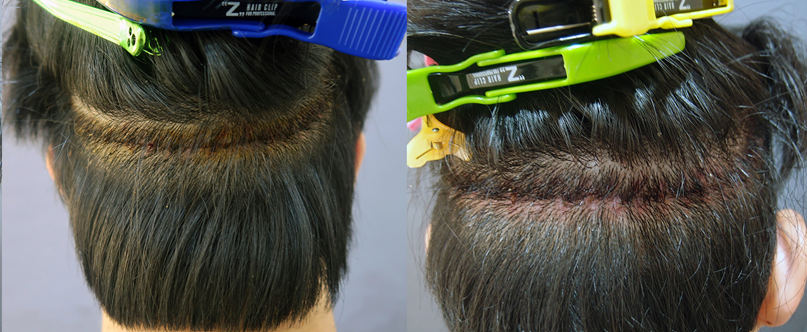
In FUT, a thin strip of scalp is removed from the donor area and the wound is closed. The strip is then divided into grafts. The result is a single line scar that is normally covered by the surrounding hair, but it can show if the hair is cut very short.
No. The International Society of Hair Restoration Surgery states that there is no such thing as scarless hair transplant surgery. FUE leaves small marks spread over the donor area; FUT leaves one line. Which is less noticeable depends on how you wear your hair.
Both methods are used for small and large sessions. The number of grafts that can be taken safely depends mainly on donor density and scalp condition, which the doctor assesses. In some large cases, doctors combine the two.
For how the number is decided, see how many grafts you may need; for the shaving options within FUE, see shaved, line-cut and non-shaven FUE.
Prices differ by method; see hair transplant cost in Korea.
This guide is general information, not medical advice. Whether a treatment suits you, and how many grafts you need, is decided by a doctor after examining your scalp. KAN HAIR is a coordination service, not a clinic.
This guide is general information, not medical advice. KAN HAIR is a coordination service operated by Hills Advisory Korea, a registered foreign patient facilitator in Korea. We are not a clinic: a doctor at the clinic examines you and decides whether a treatment is suitable.