

Women consider a hair transplant for two different reasons: to change the shape or position of the hairline, or to add density where hair has thinned. The two are planned differently, and a transplant is not suitable for every kind of hair loss.
This guide explains the difference and what a doctor assesses before recommending surgery. It is general information, not medical advice.
Some women have a high hairline without any hair loss. Hair can be transplanted in front of the existing hairline to lower it. The purpose is design and facial proportion, not treatment of hair loss.
Grafts can be placed only where coverage is needed and blended into the existing hairline. The temples connect with the contours of the face, so hair direction and angle matter a great deal here.
Natural hairlines are rarely symmetrical. The usual aim is a hairline that suits the face and the existing direction of growth, not two identical sides.
Female pattern hair loss often shows as more diffuse thinning, commonly over the top of the scalp, while the frontal hairline is kept. Adding density here means placing grafts among existing hairs, which needs a different plan from hairline design.
In hairline correction, overall density is usually good. The main decisions are how far to lower the hairline and how to shape it.
When the concern is thinning, the doctor also has to assess the existing hair, how far the thinning has progressed and, above all, the donor area. A transplant does not create new follicles. It moves existing follicles from the donor area to where coverage is needed. If the donor hair is also thinning, there may not be enough stable hair to move.
No. Hair loss in women has several causes. If hair loss came on suddenly, or the thinning is spread across the whole scalp, the cause usually needs to be identified first. A doctor, such as a dermatologist, can do that and explain the options, which may not include surgery.
Lowering the hairline as far as possible does not by itself look natural. The design takes into account the length and width of the face, the position of the existing hairline, the transition from the centre to the sides and the shape of the temples.
A natural hairline is not a straight line. Finer hairs are typically placed at the very front, with density increasing behind them so the transplanted area blends with existing hair.
It varies widely. Filling a small area at the temples is very different from lowering the whole hairline or adding density at the crown. The number depends on:
Graft numbers from another person's case cannot be applied to yours. The doctor sets the number after examining the treatment area and the donor area together.
The general principles are in how many grafts you may need.
Both are used. In follicular unit extraction (FUE), follicular units are removed one at a time. Part or all of the donor area may need to be trimmed short, although some clinics trim only a limited section that longer hair can cover.
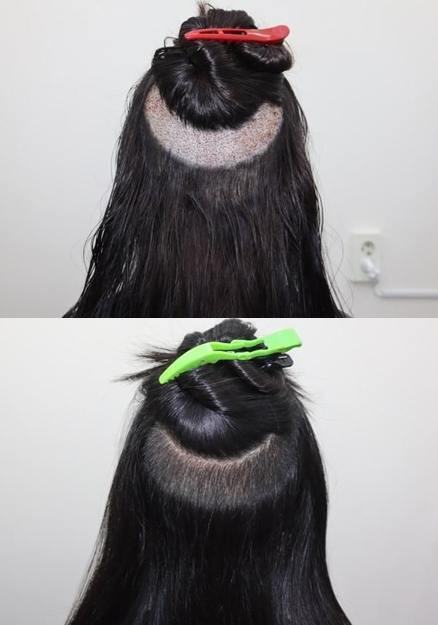
In strip surgery (FUT), a narrow strip of scalp is removed and divided into follicular units. It leaves a linear scar, but the surrounding hair does not need wide shaving, so long hair can usually cover the donor site.
Neither method is better in general. The choice depends on the number of grafts, the donor area, how much shaving is involved and your usual hairstyle, and it is made with the doctor.
A general comparison of the two methods is in FUE vs FUT; shaving options are in shaved, line-cut and non-shaven FUE.
This guide is general information, not medical advice. KAN HAIR is a coordination service operated by Hills Advisory Korea, a registered foreign patient facilitator in Korea. We are not a clinic: a doctor at the clinic examines you and decides whether a treatment is suitable.