


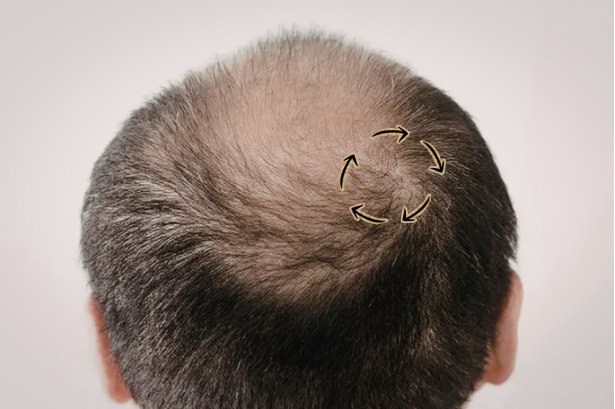
When considering a hair transplant, the hairline is often the first area people think about.
But for many patients, thinning at the crown (or vertex) is just as much of a concern — and the two areas are often treated together.
One of the most common questions is:
“How many grafts do I need for my crown?”
There is no single number that applies to everyone.
A relatively small area of crown thinning with plenty of existing hair may show a noticeable improvement with fewer grafts.
If the thinning covers a wider area, or if the hairline and frontal area also need to be restored, the bigger question becomes how the available donor grafts should be distributed across the scalp.
The crown also has a unique growth pattern.
Hair spreads in different directions around the natural whorl, so the result depends not only on how many grafts are transplanted, but also on where they are placed, at what density, and in which direction.
This is why crown transplantation is better planned as part of an overall hair restoration strategy rather than around a fixed graft number.

A crown hair transplant involves taking healthy hair follicles, usually from the back and sides of the scalp, and transplanting them into areas of thinning or hair loss at the crown.
The donor grafts may be harvested using FUE (Follicular Unit Extraction) or FUT (Follicular Unit Transplantation).
The appropriate method depends on factors such as the number of grafts required, donor density, hairstyle preferences and how the patient feels about scarring.
What makes the crown different from the frontal hairline is its natural growth pattern.
At the front, hairline design is largely influenced by facial proportions and the direction of the surrounding hair.
At the crown, the hairs typically rotate around a natural whorl, spreading in multiple directions.
A natural-looking crown therefore requires more than simply filling an empty area. The transplanted hairs need to follow the existing direction and angle of the patient's natural whorl.

Two patients with similar-looking crown thinning may require very different treatment plans.
The size of the thinning area matters, but it is only one part of the calculation.
Crown thinning may begin as a relatively small area around the whorl and gradually expand outwards.
A crown with extensive hair loss will naturally require a different approach from one where plenty of existing hair remains and the scalp is only beginning to show through.
Even when two areas appear similar in size, the amount of existing hair can change how much additional density is needed.
Crown hair does not grow in a single direction.
It rotates around the centre of the whorl and spreads outwards. Simply adding density without considering this pattern can make the result look unnatural.
For this reason, crown transplantation is not only about how many grafts are used, but where they are placed and at what angle and direction.
Hair thickness, existing density and the contrast between the hair and scalp can all affect how much coverage a transplant appears to provide.
The crown's multidirectional growth pattern also means that the same number of grafts may produce a different visual effect from one patient to another.
This is why a statement such as “2,000 grafts will cover this much of the crown” can be misleading without first assessing the individual scalp.
The number of grafts required should instead be determined by looking at the area of hair loss, existing hair, whorl pattern, target density and available donor supply together.
The crown should ideally be assessed as part of the entire scalp rather than as an isolated area.
Even when two patients appear to have a similar degree of crown thinning, differences in existing hair density, hair thickness and whorl pattern can result in very different graft requirements.
It is also common for patients to undergo transplantation to the hairline, frontal area and crown during the same procedure.
In these cases, the more important question may not be:
“How many grafts does my crown need?”
but rather:
“How should my available donor grafts be divided between the hairline, frontal area and crown?”
This is also why comparing your crown with another patient's before-and-after photos and graft count has limitations.
The overall pattern of hair loss and the available donor supply need to be considered together.
The goal of a crown transplant does not always have to be creating enough density that no scalp is visible at all.
When existing hairs remain in the crown, transplanted grafts can be placed between them to reduce visible scalp and create the appearance of greater overall density.
-p-1080.jpg)
The result will vary depending on the extent of hair loss, existing hair and donor characteristics.
For this reason, before-and-after photographs are most useful for understanding how crown coverage can change after transplantation, rather than assuming that the same graft count will produce the same result for another person.
When both the hairline and crown are affected, how the available donor hair is allocated becomes particularly important.
The number of follicles that can be safely harvested from the donor area is finite.
Trying to create maximum density across every area of hair loss is therefore not always the most appropriate long-term strategy.
For example, if the hairline has noticeably receded and the crown is also thinning, but donor availability is limited, one option may be to allocate relatively more grafts to the hairline and frontal area, which have a strong influence on the appearance of the face.
The crown may then be treated at a somewhat lower density across a wider area to improve overall coverage while preserving donor grafts.
On the other hand, if the hairline is relatively stable and crown thinning is the patient's primary concern, allocating more grafts to the crown may make more sense.
There is therefore no universal answer to the question:
“Should I treat my hairline or crown first?”
The current pattern of hair loss, possible future progression and available donor supply should all be considered as part of a longer-term plan.
.png)
When both the frontal area and crown need treatment, using the highest possible density in every area may not always be the best approach — especially when donor hair is limited.
In some cases, more grafts may be allocated to the hairline and frontal area, while the crown is transplanted at a lower density to improve coverage without using too much of the available donor supply.
For patients who still feel that the scalp is visible at the crown after the transplanted hair has fully grown, Scalp Micropigmentation (SMP) may be considered as an additional option.
SMP does not add new hair. Instead, small deposits of pigment are applied to the scalp to reduce the contrast between the hair and scalp, making areas of lower density appear less noticeable.

This can provide another option for patients who want to improve the appearance of crown density without using additional donor grafts.
A possible long-term approach may therefore be:
Prioritise the hairline and frontal area → improve crown coverage with an appropriate density → preserve donor grafts for the future → consider SMP later if additional visual density is desired.
SMP is not necessary for every patient. Whether it is suitable should be assessed after the scalp has healed and the transplanted hair has had sufficient time to grow.
Not necessarily.
Donor hair is a limited resource.
Once a follicular unit has been removed from the donor area and transplanted, it cannot be used again in the future.
Planning therefore involves more than deciding how many grafts can be placed into the crown today. It also means considering how much donor hair should remain available if hair loss continues in the future.
This becomes particularly important when both the frontal area and crown are affected, or when the patient's hair loss may continue to progress.
A good transplant plan is therefore not simply about:
“Using as many grafts as possible.”
It is about:
“Using the available grafts where they can provide the most benefit while preserving donor options for the future.”
A hair transplant does not stop the progression of hair loss in the existing, non-transplanted hair.
If the native hairs surrounding the transplanted area continue to become thinner or fall out, the scalp may become more visible again over time.
This is particularly relevant to the crown because the thinning area can gradually expand beyond the area that was originally transplanted.
A crown transplant should therefore not be planned solely around the area that appears thin today.
A proper assessment should also consider:
Where appropriate, patients can also discuss medical hair-loss treatment with their doctor as part of a longer-term strategy.
Transplanted hair does not immediately begin growing into the final result.
The transplanted hairs may initially shed before new growth begins. Over time, the new hairs become longer and thicker, gradually contributing to the final density.
One important difference is that growth in the crown can appear more slowly than growth in the hairline or frontal area.
This means that even when the hairline and crown are transplanted during the same procedure, changes at the hairline may become noticeable earlier while the crown still appears relatively thin.
It can therefore be too early to assume:
“My hairline is growing well, but the crown has not taken.”
The crown's whorl pattern can also make the early stages of growth more difficult to assess because short hairs are spreading in several directions rather than creating immediate visual coverage.
For crown transplantation, it is therefore particularly important to allow sufficient time for growth, thickening and coverage to develop before judging the final result.
.png)
It is understandable that one of the first questions when considering a crown hair transplant is:
“How many grafts will I need?”
Graft count is important, but the crown cannot be planned simply by filling an empty area with a predetermined number of follicles.
The size of the thinning area, natural whorl direction, existing density, donor condition, frontal hair loss and possible future progression all need to be considered together.
This becomes even more important when both the hairline and crown are affected.
Rather than looking only at a single procedure, the goal should be to decide how a finite donor supply can be used across the scalp over the long term.
For some patients, that may mean adjusting crown density, preserving more donor hair for the future, or considering complementary options such as SMP once the transplant has fully grown.
When comparing treatment plans, it can therefore be more useful to ask not simply who is recommending the largest number of grafts, but:
Why are that many grafts needed, how will they be distributed between the hairline and crown, and how does the plan account for the donor hair you may need in the future?