


If you are considering a hair transplant in Korea, you may come across Non-Shaven FUE, a technique designed to minimise or avoid visible shaving of the donor area.
It can be particularly appealing if you need to return to work quickly, want to maintain your existing hairstyle, or simply do not want your hair transplant to be obvious to the people around you.
With conventional FUE, part of the donor area at the back of the head is usually trimmed short before the grafts are extracted.
With Non-Shaven FUE, the surrounding hair is kept long while the follicles required for transplantation are selectively harvested.
This allows the longer hair to fall over the donor area after surgery, making the extraction sites easier to conceal.
There is, however, one obvious difference:
Non-Shaven FUE usually costs more.
So is it simply a more expensive version of FUE because you do not have to shave your donor area?
Not quite.
There is another important point to understand when comparing Non-Shaven FUE clinics in Korea:
Not every clinic performs Non-Shaven FUE in exactly the same way.
The way donor hairs are prepared, the tools used and the harvesting technique can differ between clinics.
These differences can affect procedure time, cost and how the donor area looks immediately after surgery.

FUE, or Follicular Unit Excision, is a hair transplant technique in which individual follicular units are extracted from the donor area, usually at the back and sides of the scalp.
With conventional FUE, the donor hair is generally trimmed short before extraction.
This gives the surgical team a clearer view of the scalp and makes it easier to identify the direction of individual follicles and harvest grafts efficiently.
With Non-Shaven FUE, a large visible section of the donor area does not need to be shaved.
Instead, the surgical team works between the longer existing hairs to harvest the required grafts.
The surrounding hair can then cover the donor area after surgery, helping to reduce the visible signs of harvesting.
This can be particularly useful for people with longer hairstyles, women undergoing hairline transplantation, or anyone who needs to return to work without an obvious shaved area at the back of the head.
However, Non-Shaven FUE does not mean that the entire hair transplant is invisible.
The donor area may be easier to conceal, but the recipient area can still show redness and small scabs during the early recovery period.
Both procedures are forms of FUE.
The main difference is how the donor hair is prepared before the grafts are harvested.
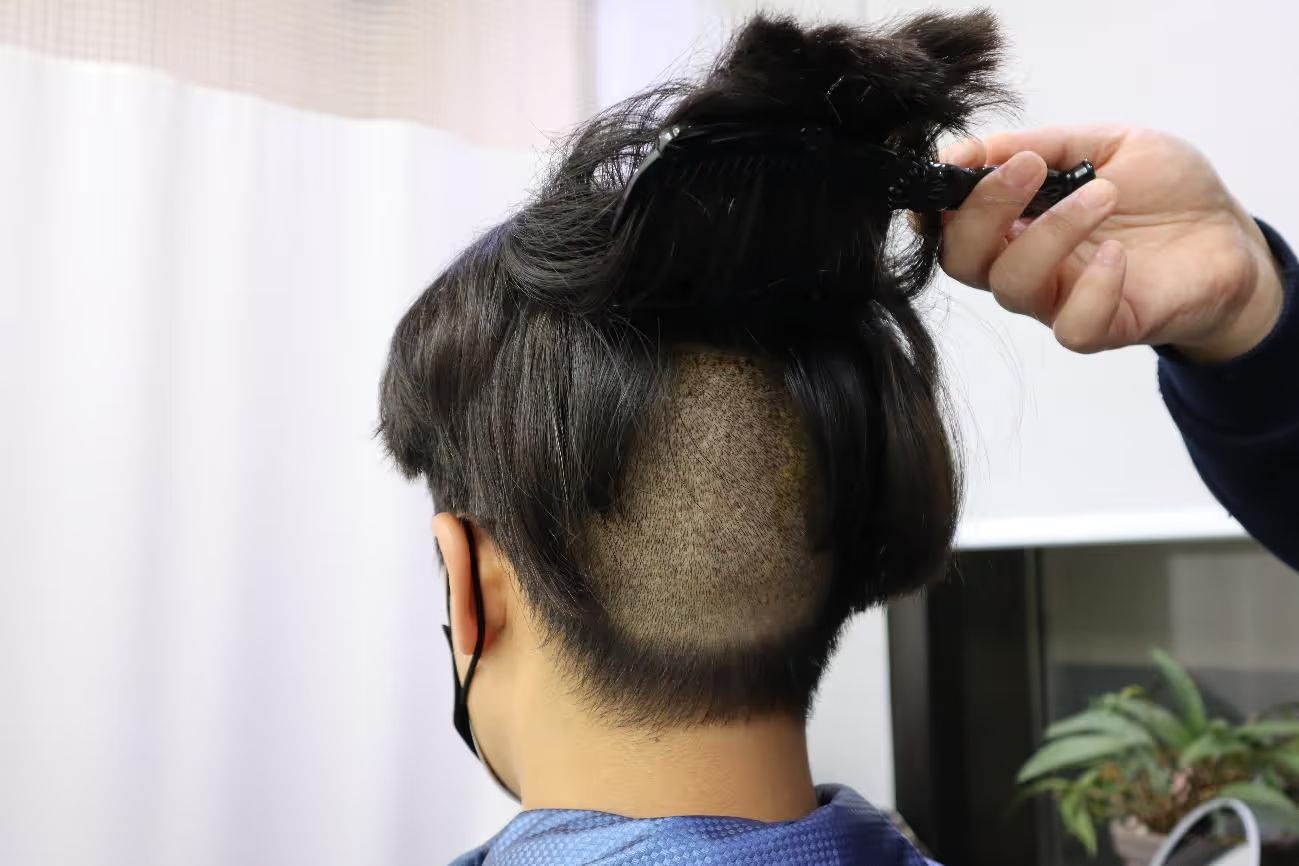
With conventional FUE, a section of the donor area is trimmed short before follicular units are extracted.
Because the hair is short, the surgical team can see the scalp and hair direction clearly and harvest grafts efficiently.
This can be particularly useful when a large number of grafts is required.
The trade-off is that the trimmed donor area may be visible immediately after surgery.
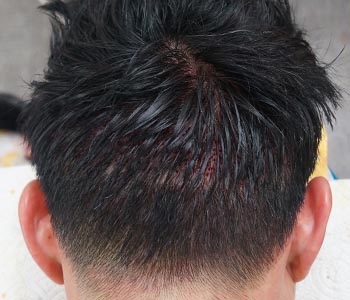
With Non-Shaven FUE, the surrounding donor hair remains long.
The surgical team works between the longer hairs to identify and harvest the required follicles.
This helps preserve the existing hairstyle and makes the donor area easier to conceal after surgery.
However, working between longer hairs can require more detailed preparation and additional procedure time.
This is one of the reasons Non-Shaven FUE often costs more.
This is one of the most important things to understand when comparing clinics.
Two clinics may both provide a quotation for:
“2,000 grafts — Non-Shaven FUE”
but the actual procedure may not be identical.
The way the donor hairs are prepared and harvested can differ between clinics.
Research on Non-Shaven FUE also describes different approaches, including pre-trimmed techniques, direct techniques and Long-Hair FUE.
This is why it is important to look beyond the name of the procedure and understand what will actually happen to your donor hair.
With the pre-trimming method, the surrounding donor hair remains long, while only the hairs selected for extraction are shortened before harvesting.
Instead of shaving a large section of the donor area, the surgical team selectively trims the target hairs.
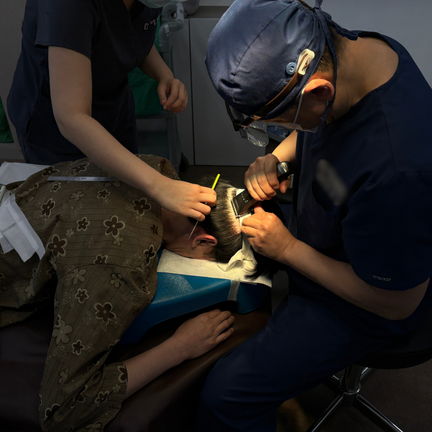
Clinical descriptions of this technique report target hairs being trimmed to approximately 1–2 mm before extraction.
The surrounding hair remains long and can cover the shorter donor hairs after surgery, helping to conceal the extraction area.
In other words, the donor area is not broadly shaved, but the individual hairs that will actually be harvested may still be shortened.
This is an important distinction when a clinic describes a procedure as “Non-Shaven FUE”.
Some clinics use a particularly manual approach to pre-trimming.
The hairs selected for extraction are identified between the longer surrounding hairs and individually shortened with fine scissors before the corresponding follicles are harvested.
This can involve a considerable amount of detailed work.
Imagine a procedure requiring 2,000 grafts.
Rather than trimming a larger donor area at once, the surgical team must repeatedly identify the appropriate donor hairs among the longer hair and prepare the selected hairs individually.
Published clinical techniques have described the use of fine scissors and magnification to pre-trim selected donor hairs before extraction.
This additional preparation can increase the amount of work and time required for the procedure.
It is one reason why the price of Non-Shaven FUE can vary between clinics, even when the graft count appears to be the same.
Not every Non-Shaven FUE procedure requires the target hairs to be individually pre-trimmed with scissors.
A direct Non-Shaven FUE technique can also be used.
With this method, the target hair is not individually shortened beforehand. Instead, a motorised punch cuts the hair shaft as the follicular unit is punched, combining hair cutting and punching in one step.
This means two clinics can both offer “Non-Shaven FUE” while using different harvesting protocols.
Clinics may also use different instruments and their own variations of these techniques.
This is why, instead of asking only:
“Do I need to shave my donor area?”
it is worth asking:
“How are the donor hairs prepared and harvested for your Non-Shaven FUE?”
There is also a technique in which the hair shaft of the harvested graft is kept long.
This is generally referred to as Long-Hair FUE.
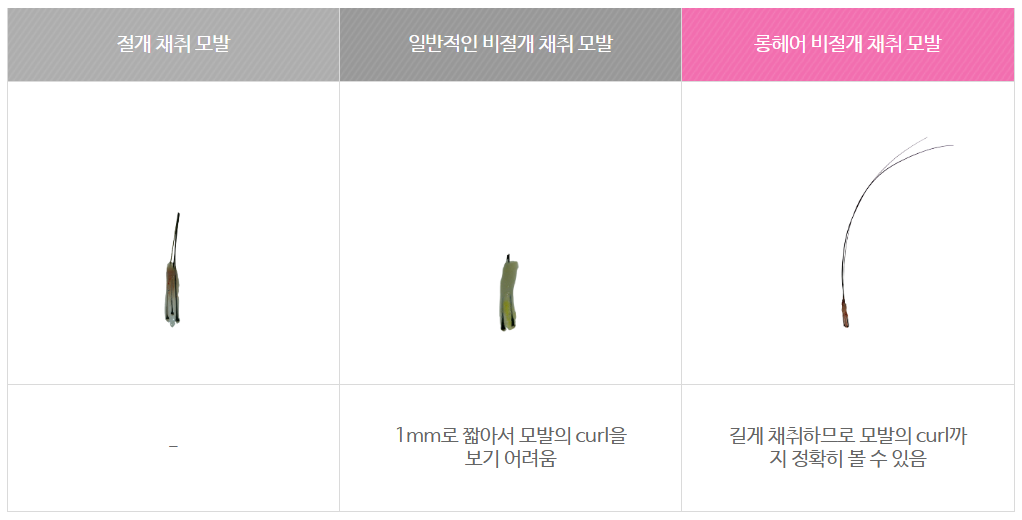
Unlike pre-trimmed Non-Shaven FUE, the target donor hairs are not shortened to around 1–2 mm before extraction.
Specialised harvesting techniques can be used to extract the follicular unit while maintaining a longer hair shaft.
Long-Hair FUE can help preserve the visible hairstyle and can also allow the surgeon to observe characteristics such as hair curl during placement.
However, it is a more specialised technique, and the exact method, availability, procedure time and cost can vary between clinics.
You may therefore encounter terms such as:
Non-Shaven FUE / No-Shave FUE / No-Cut FUE / Long-Hair FUE
when researching clinics.
These names should not automatically be assumed to describe exactly the same procedure.
The more useful questions are:
What hair will actually be cut? How short will it be cut? And how will the grafts be harvested?
This is another detail worth checking when comparing clinics.
The way donor hair is prepared can differ between clinics.
Some may use trimming devices for part of the donor preparation, while others may selectively prepare individual donor hairs with scissors.
The important point is not to assume that:
clippers = worse
or
scissors = better
The tool itself does not determine the final quality of a hair transplant.
Instead, ask how much donor hair will actually be shortened, how the target grafts are selected, and how visible the trimmed area is expected to be after surgery.
For example, one clinic may minimise visible shaving while using a trimming device to prepare a limited donor area efficiently.
Another clinic may individually select and pre-trim donor hairs with scissors, which can require more manual work.
So if one Non-Shaven FUE quotation is considerably more expensive than another, it is worth checking what each procedure actually includes before assuming you are comparing the same technique.
Not necessarily.
Individually selecting and pre-trimming donor hairs with scissors does not automatically mean better graft survival or a better final result.
Likewise, using another Non-Shaven harvesting method does not automatically mean an inferior result.
A clinical study comparing pre-trimmed and direct Non-Shaven FUE found that the pre-trimmed method took longer to punch the same number of grafts.
In that study, there was no statistically significant difference in transection rate between the two techniques. PubMed Central (PMC)
The final result of a hair transplant depends on many factors, including:
The main advantage of Non-Shaven FUE is therefore not that it automatically produces a better final result.
Its main value is reducing the visible change to your existing hairstyle during the procedure and early recovery period.
One of the main reasons is time and workload.
With conventional FUE, the donor hair is already trimmed short, allowing the surgical team to identify and harvest grafts efficiently.
With Non-Shaven FUE, the team works between longer hairs.
Depending on the technique, the process may involve:
selecting donor hairs → individual pre-trimming → identifying follicle direction → punching → graft extraction
repeated across hundreds or thousands of grafts.
So the additional price of Non-Shaven FUE should not be understood simply as a fee for “not shaving”.
Depending on the technique, it can reflect additional preparation, procedure time and a more labour-intensive donor harvesting process.
The biggest advantage is simple:
you can preserve more of your existing hairstyle during the procedure.
Because a large section of the donor area does not need to be shaved short, the surrounding longer hair can help conceal the extraction sites.
Non-Shaven FUE may therefore be particularly worth considering if:
For someone travelling from Singapore to Korea, this can be particularly relevant.
After spending a few days in Korea, you may need to return to Singapore and resume work or daily life.
If an obvious shaved donor area would be a major concern, the additional cost of Non-Shaven FUE may be worthwhile.
Non-Shaven FUE is often more expensive, but that does not make it the best option for every patient.
If you normally keep your hair short, or if having a visible trimmed donor area for a period after surgery is not a major concern, conventional FUE may be a more economical choice.
The number of grafts required also matters.
As the graft count increases, donor harvesting time and the cost difference between techniques can become more significant.
So rather than thinking of the options as:
Conventional FUE < Non-Shaven FUE
in terms of quality, it is better to choose based on your lifestyle, donor characteristics, graft requirements and budget.
This is a common concern.
You may want to avoid shaving the back of your head, but after receiving a Non-Shaven FUE quotation, find that the cost is higher than expected.
Does that mean you have to give up on the idea of a hair transplant?
No.
FUE does not always come down to just two choices:
a visibly shaved donor area or fully Non-Shaven FUE.
There are also partial-shaving approaches designed to reduce the visible disadvantages of shaving while allowing grafts to be harvested more efficiently.
Depending on the clinic, these may be described as Line-Cut FUE, partial-shave FUE, minimal-shave techniques or clinic-specific methods such as Micro Cut.
With Line-Cut FUE, a large donor area is not shaved.
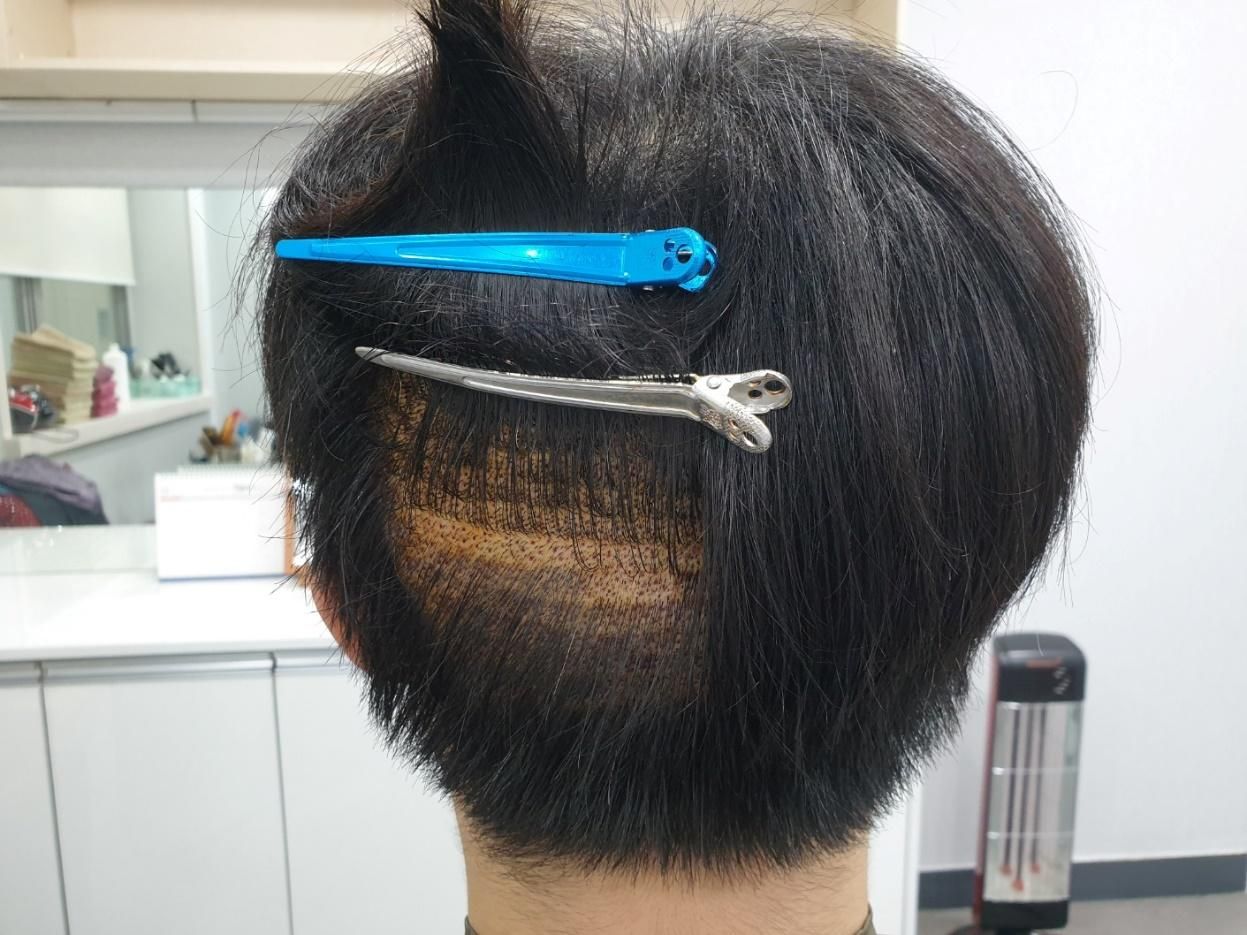
Instead, one or more narrow sections beneath the longer hair are trimmed short, and grafts are harvested from these sections.
After surgery, the longer hair above can fall over the shortened areas and help conceal them.
The basic idea is to create enough short hair for efficient harvesting while reducing how much shaving is visible from the outside.
For someone who thinks:
“I don't want the back of my head broadly shaved, but I don't necessarily need fully Non-Shaven FUE.”
Line-Cut or another partial-shave technique can provide a practical middle option.
It may also cost less than fully Non-Shaven FUE because individual donor hairs do not necessarily need to be prepared one by one.
However, suitability depends on your hair length, donor characteristics and the number of grafts required.
Some Korean clinics use terms such as Micro Cut, Fine Cut, Nano Cut or other clinic-specific names for techniques designed to reduce the visible amount of shaving.
These terms require some caution.
“Micro Cut” is not a universally standardised medical classification.
Depending on the clinic, it may refer to small shaved donor sections, multiple concealed harvesting areas or another variation of partial shaving.
So the name itself is less important than what the clinic actually does.
Before choosing this type of procedure, ask:
This is much more useful than comparing names such as “Micro Cut” or “Nano Cut” alone.
A better way to think about FUE donor preparation is as a range of options.
A larger donor area is trimmed short.
Main advantage: efficient harvesting and generally lower cost.
Main trade-off: the trimmed donor area is more visible after surgery.
One or more limited areas are trimmed beneath longer surrounding hair.
Main advantage: the trimmed areas can often be concealed while allowing relatively efficient harvesting.
Main trade-off: some donor hair still needs to be cut short.
Smaller or distributed donor areas are trimmed to reduce visible shaving.
Main advantage: less visible shaving than conventional FUE.
Main trade-off: the exact method and terminology vary between clinics.
The surrounding donor hair remains long while target follicles are selectively harvested.
Main advantage: easier to preserve and conceal the existing hairstyle.
Main trade-off: more detailed preparation and usually higher cost.
Grafts are harvested while retaining longer hair shafts.
Main advantage: maximum preservation of visible hair length.
Main trade-off: a more specialised procedure, with availability, operating time and cost varying between clinics.
The key point is that wanting to avoid an obvious shaved donor area does not automatically mean you need the most expensive option.
Start with a simple question:
How much shaving are you actually comfortable with?
If you need your donor area to look as unchanged as possible after surgery and your budget allows it, Non-Shaven FUE may be worth considering.
If your main concern is simply avoiding a large visible shaved patch, Line-Cut or another partial-shave approach may already meet your needs at a lower cost.
And if shaving is not a major concern, conventional FUE may allow you to reduce the cost of your procedure without being an inherently inferior transplant technique.
The decision should take into account:
graft count + donor density + current hair length + hairstyle + return-to-work schedule + budget
rather than price or the name of the technique alone.
The main value of Non-Shaven FUE is not that it guarantees a better hair transplant result.
Its value is that it can reduce the visible disruption to your existing hairstyle during the procedure and early recovery period.
So instead of asking:
“Is Non-Shaven FUE the best hair transplant technique?”
a more useful question is:
“Is avoiding visible shaving important enough to me to justify the additional cost?”
And if full Non-Shaven FUE is outside your budget, you do not necessarily have to give up on a hair transplant.
Depending on the clinic and your donor hair, Line-Cut, partial-shave and other minimal-shave techniques may provide alternatives between conventional FUE and fully Non-Shaven FUE.
The goal is not to choose the most expensive technique.
It is to find the right balance between appearance, graft requirements, procedure time and budget for your own situation.
KAN HAIR works with partner clinics in Korea that offer different donor harvesting approaches, including conventional FUE, Line-Cut and partial-shave techniques, and Non-Shaven FUE.
Rather than comparing procedure names alone, we can help you compare how different clinics approach donor harvesting, how much shaving is involved, the expected graft count and the cost.
If you are considering a hair transplant in Korea but are concerned about shaving the donor area, you can send us photos of your current hair together with your preferred hairstyle and return-to-work schedule.
We can help you compare the available options before deciding which approach best suits your needs.