


When we meet someone for the first time, their face creates our very first impression.
What many fail to realize is that the hairline plays an incredibly pivotal role in shaping that impression.
Although hair covers more than half of the human head's visible surface area, its overall structural impact on the face is frequently overlooked. In daily conversations, we routinely describe unfamiliar people by their hair—such as "the person with their hair tied up," "the one with the bob cut," or "the person with curly hair."
This goes to show just how deeply hairstyles and hairlines define an individual's identity.
In recent years, interest in hairline correction has surged globally.
However, this is far from a simple, superficial cosmetic fix.
It is a highly sophisticated, multifaceted procedure designed to recontour the face, establishing a more natural, balanced, and harmonious facial silhouette.
In this comprehensive guide, we will explore the criteria for an ideal hairline, the nuances of autologous hair transplantation for hairline adjustment, and the critical factors every patient must consider before undergoing surgery.

A person's hairline, forehead border, and overall hairstyle exert a much greater psychological and visual impact than most assume.
Because we often gloss over the fact that hair occupies more than half of the face’s total landscape, it inherently becomes the primary marker for facial recognition and description.
If your hairline feels unproportional or receded, it can inadvertently alter your entire facial expression, making you look older or more stressed than you actually are.

Just as there are universally recognized aesthetic proportions for the face, there is a "golden ratio" for an ideal hairline position.

Generally, a face is considered perfectly balanced when the vertical distances between the following points follow a 1:1:1 ratio:


A Note on Individuality: This ratio is not an absolute, rigid law. It serves as a foundational guide. True aesthetic success requires a surgeon to customize these measurements to complement your unique features and bone structure.


When designing a hairline, understanding ethnic anatomical variations is crucial:


Because of this brachycephalic structure, East Asians naturally tend to have a wider forehead profile from a frontal view, which can make the cheekbones look prominent and the face appear wider or flatter.

This is why hairline correction in South Korea is widely viewed as a form of facial contouring surgery.
By strategically advancing the hair border and narrowing the temporal areas, surgeons can visually diminish the broad space between the eyes and the zygomatic arch (cheekbones), creating a significantly smaller, softer, and more oval-shaped face.
For patients with a naturally high forehead or genetic hair loss, a hairline transplant can effectively lower the entire top border.

Bringing the hairline down to meet the golden ratio yields a remarkable visual shift, balancing the upper face and giving the patient a much more youthful appearance.


Sharp, angular, or M-shaped hairlines typically project a more masculine or stern impression. Conversely, a smooth, rounded, and flowing hairline creates a softer, distinctly feminine look.


Many women naturally have fine "baby hairs" that soften their hairlines in youth. However, as they reach their 20s and 30s, these fine hairs can naturally thin out, exposing sharp, square corners. Restoring these corners with delicate graft placement re-establishes a soft, curved frame for the face.
The "temporal peak" is the slight outward curve of hair located roughly 45 degrees upward from the eyebrow.


Advancing this peak and connecting it seamlessly down toward the sideburns is one of the most effective ways to reduce the apparent width of the face from a profile or three-quarter view.


While women’s sideburns are inherently softer and less dense than men's, their presence is vital. Subtle, wispy sideburns project a youthful vibe and help mask the cheekbone area.
For patients with prominent zygomatic bones, constructing natural, delicate sideburns can instantly achieve a slimming effect.

Many individuals with high or wide foreheads rely on full bangs to camouflage their hairlines.
However, maintaining this look can be incredibly frustrating. When the forehead is excessively broad or lacks hair volume, the bangs continuously split down the middle or sides—a phenomenon known as the "parted bangs" issue.
This splitting is particularly pronounced in individuals with an M-shaped recession.

By using hair transplantation to fill the recessed zones and increase the physical volume of hair falling forward, this issue is completely resolved.

Post-transplant, patients no longer have to spend excessive time styling their hair or constantly worry about wind, water, or sweat splitting their bangs and exposing their foreheads.
It offers an incredible boost in daily lifestyle confidence.
Creating a hairline that looks completely natural and completely undetectable requires absolute mastery over several subtle details.

A perfectly straight, flat hairline looks artificial and wig-like. To prevent this, skilled surgeons often incorporate a micro-widow's peak—a gentle, downward-pointing V-shape at the dead center of the hairline.
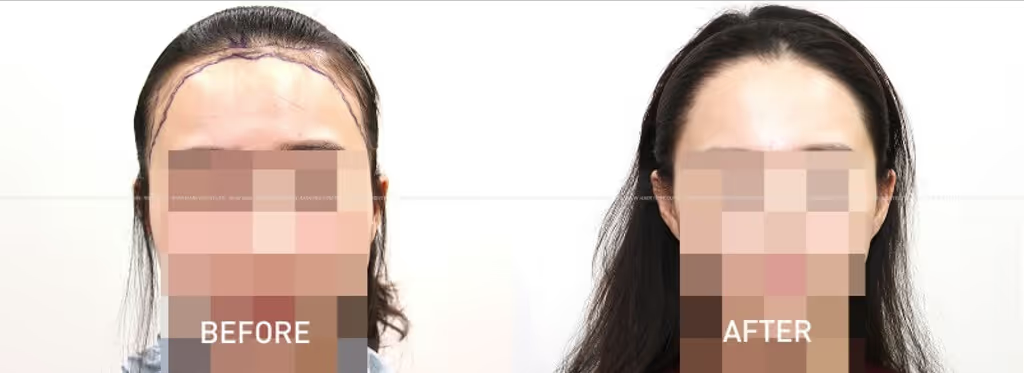


In folklore, a widow's peak was tied to various myths, but in modern aesthetics, it introduces a beautiful, intentional asymmetry. This irregularity breaks the monotony of the hairline, creating a powerful optical illusion that makes the forehead look shorter and infinitely more organic.

Hair does not grow uniformly. Every individual possesses a distinct, congenital direction and angle of hair growth across their scalp, which is rarely perfectly symmetrical.


Even on a seemingly bare forehead, microscopic examination reveals tiny, translucent vellus hairs (baby hairs). A surgeon must carefully audit the direction of these vellus hairs during the planning phase:

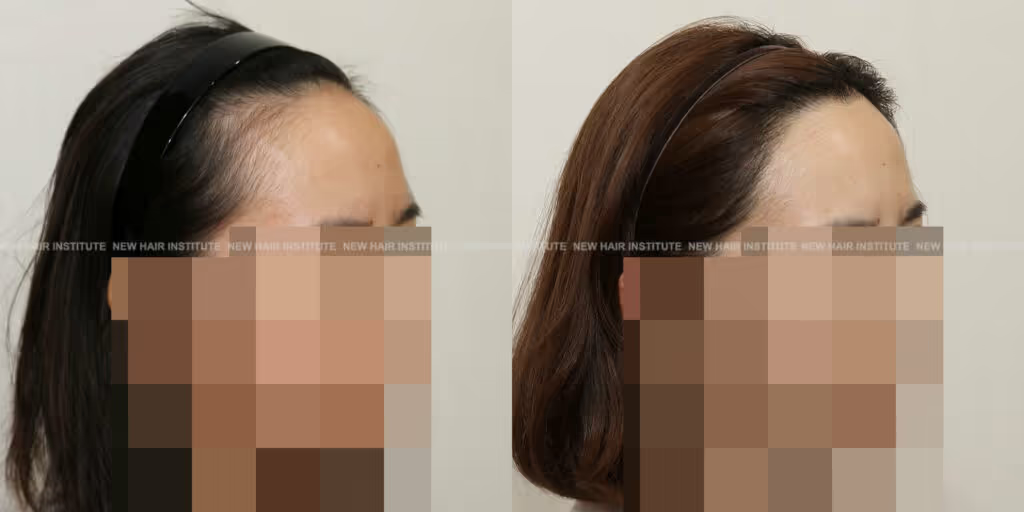


Therefore, a rigorous pre-op analysis of hair directionality and a thorough consultation with the patient regarding their native asymmetry are absolute prerequisites.


A cowlick refers to a localized cluster of hair that grows upward or in a swirling pattern rather than downward.
When designing the front hairline, the surgical team must decide whether to mimic this anomaly or bypass it.
As a general clinical rule:
Hairline correction via autologous hair transplantation is far more than a routine surgical procedure.
It sits at the intersection of medical science, biological tissue grafting, and pure artistic design.
Failing to account for even one minor detail—be it the exit angle of a single follicle or the macro-symmetry of the face—can drastically compromise the final look.
Because of this, the procedure demands an extraordinary level of clinical experience, artistic intuition, and specialized nuance.
In the global medical community, it is widely acknowledged that while a surgeon may be highly proficient at performing standard male pattern baldness transplants, mastering a delicate female hairline correction is a completely different tier of difficulty.
Conversely, an elite surgeon who can flawlessly execute a natural female hairline can perform a male transplant with ease.
Finding the right specialist requires diligence. We highly recommend thoroughly reviewing a clinic’s extensive before-and-after portfolios, evaluating their specific approach to natural flow, and visiting the clinic for a personalized diagnostic consultation to ensure your aesthetic goals align perfectly with the surgeon's expertise.