


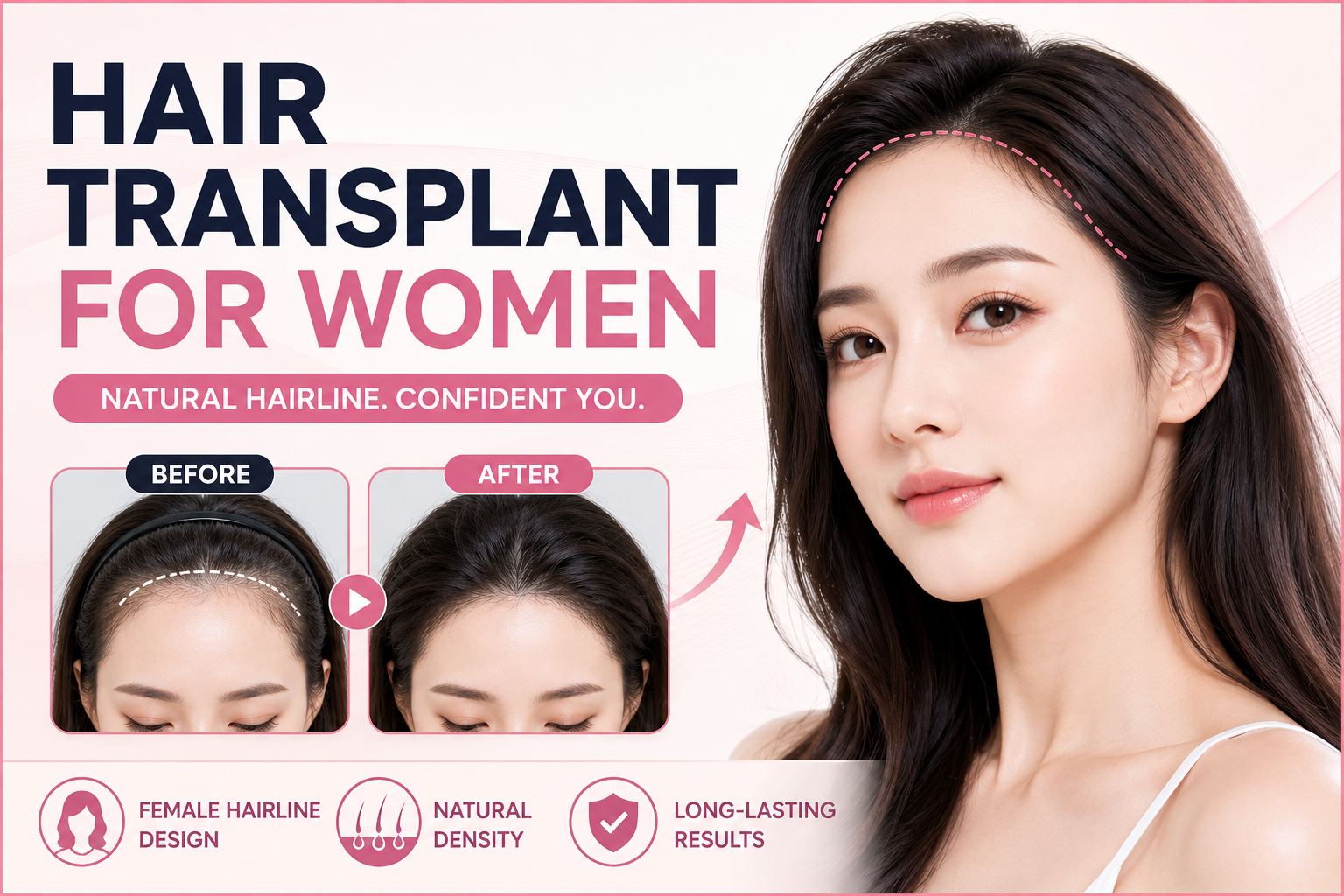
When people think about hair transplantation, male-pattern hair loss, such as a receding hairline or thinning crown, often comes to mind first.
However, hair transplants are not only for men.
Women may also consider a hair transplant for a variety of reasons, from lowering a naturally high hairline and filling in the temples to improving density in areas affected by hair thinning.
For women in Singapore considering a hair transplant, the reason for treatment can vary significantly.
Some may want to reshape their hairline for cosmetic reasons, while others may be experiencing progressive thinning around the part line or crown.
Because of these differences, female hair transplantation is not simply about moving hair to an area that looks thin.
The cause and pattern of hair loss, the condition of the donor area, the amount of existing hair and the possibility of future hair loss should all be considered before planning surgery.
In this article, we look at when a hair transplant may be suitable for women, the difference between cosmetic hairline correction and transplantation for hair loss, and what to consider before undergoing the procedure.

There is no single reason why women choose to have a hair transplant.
For some, the goal is to change the shape or position of the hairline.
For others, transplantation may be considered to restore density that has been lost due to hair thinning.
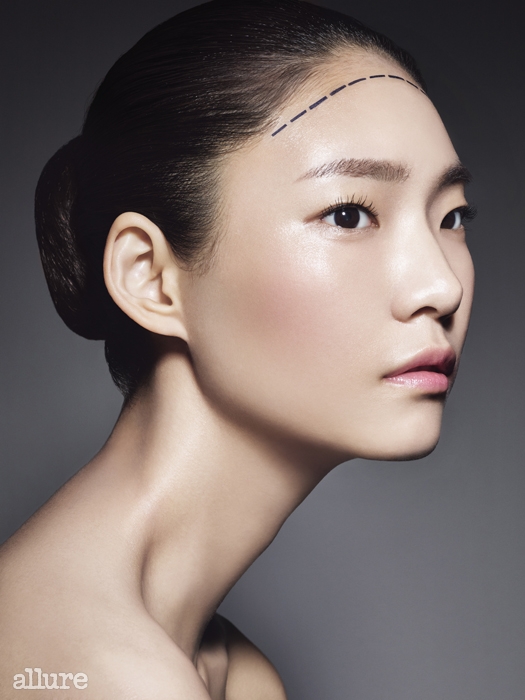
Some women naturally have a high hairline or wide forehead even without experiencing hair loss.
In these cases, hair can be transplanted in front of the existing hairline to lower its appearance and create proportions that better complement the face.
-p-2000.avif)
Rather than treating hair loss, the main purpose of the procedure is usually hairline design and adjustment of facial proportions.
.jpg)
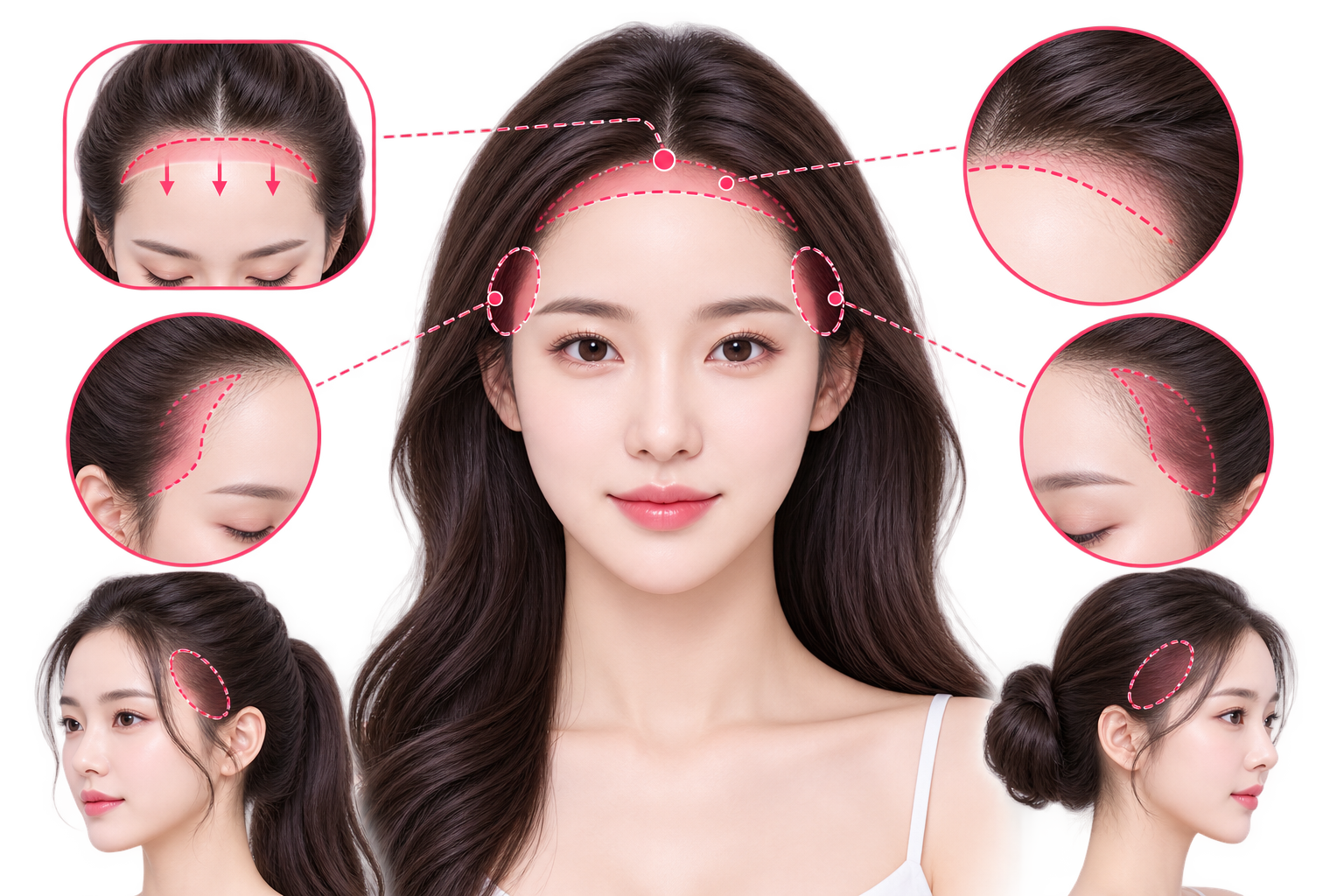
Women may also have an M-shaped hairline or naturally sparse areas around the temples.
This can make the forehead appear wider or longer even when there is no significant hair loss elsewhere.
Rather than lowering the entire hairline, grafts can be placed specifically in the areas that need additional coverage and blended into the existing hairline.
The temples and side hairline are particularly important because they connect directly with the contours of the face.
A natural result therefore depends on more than simply filling an empty space.
Hair direction, angle, facial shape and the existing growth pattern all need to be considered when designing these areas.
.png)
Hair transplantation may also be used to improve a hairline that appears uneven or has one side positioned higher than the other.
However, human faces and natural hairlines are rarely perfectly symmetrical.
Rather than creating two completely identical sides, the goal is usually to design a hairline that works naturally with the existing facial structure and direction of hair growth.
-p-1080.jpg)
Female hair loss does not always follow the same pattern commonly seen in men.
Instead of a dramatically receding hairline, some women experience a widening part line or a gradual reduction in density across the top or crown of the scalp.
Depending on the condition, hair transplantation may be considered to add density to these areas.
However, this type of procedure requires a different approach from cosmetic hairline correction because new grafts need to be placed among existing hairs.
The density of the remaining hair, the extent and progression of thinning, and most importantly, whether the donor hair at the back of the scalp is sufficiently stable and healthy should all be evaluated before surgery.
One of the most important distinctions when considering a hair transplant for women is whether the goal is to change the shape of the hairline or to restore density lost through hair thinning.
Hairline correction may be considered when overall hair density is relatively good but the patient has:
In these cases, the number of grafts is only one part of the treatment plan.
How far the hairline should be lowered and how it should be shaped can have a significant impact on the final appearance.
When the concern is actual thinning around the part line, crown or other areas of the scalp, design alone is not enough to determine the treatment plan.
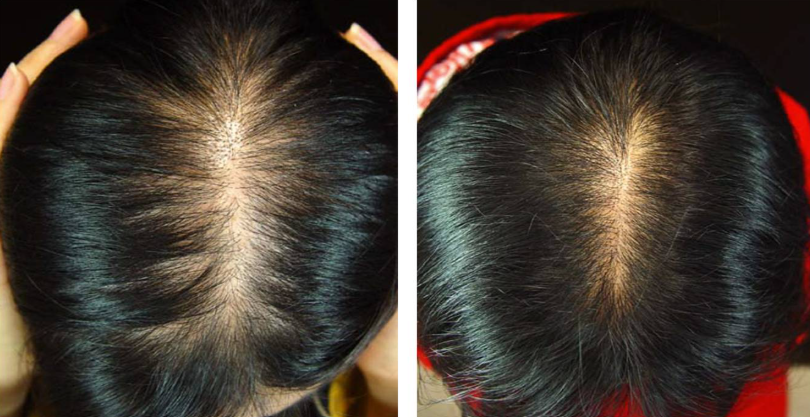
The condition of the existing hair, the extent of hair loss, its progression and the donor area all need to be evaluated.
Some forms of female hair loss can involve diffuse thinning across a larger area of the scalp.
If the hair in the donor area is also becoming thin, there may not be enough stable donor hair available for transplantation.
This is because a hair transplant does not create new hair follicles.
It redistributes existing follicles from the donor area to areas where additional coverage is needed.
Not necessarily.
Experiencing thinning or increased hair shedding does not automatically mean that hair transplantation should be the first option considered.
Female hair loss can have different causes.
If hair loss develops suddenly or thinning occurs diffusely across the scalp rather than in a clearly defined area, the underlying cause may need to be evaluated first.
A successful hair transplant also depends on having a sufficiently stable donor area from which healthy follicles can be harvested.
For this reason, determining the number of grafts needed should not necessarily be the first step when considering a female hair transplant.
It is equally important to assess the pattern and progression of hair loss, the area that requires transplantation and the condition of the donor hair.
For women considering a hair transplant in Singapore or overseas, it can therefore be helpful to first determine whether the main concern is the shape of the hairline or progressive hair loss.
For women considering transplantation to correct a wide forehead, M-shaped hairline or sparse temples, hairline design can be just as important as the number of grafts transplanted.
Simply lowering the hairline as much as possible does not necessarily create a natural-looking result.
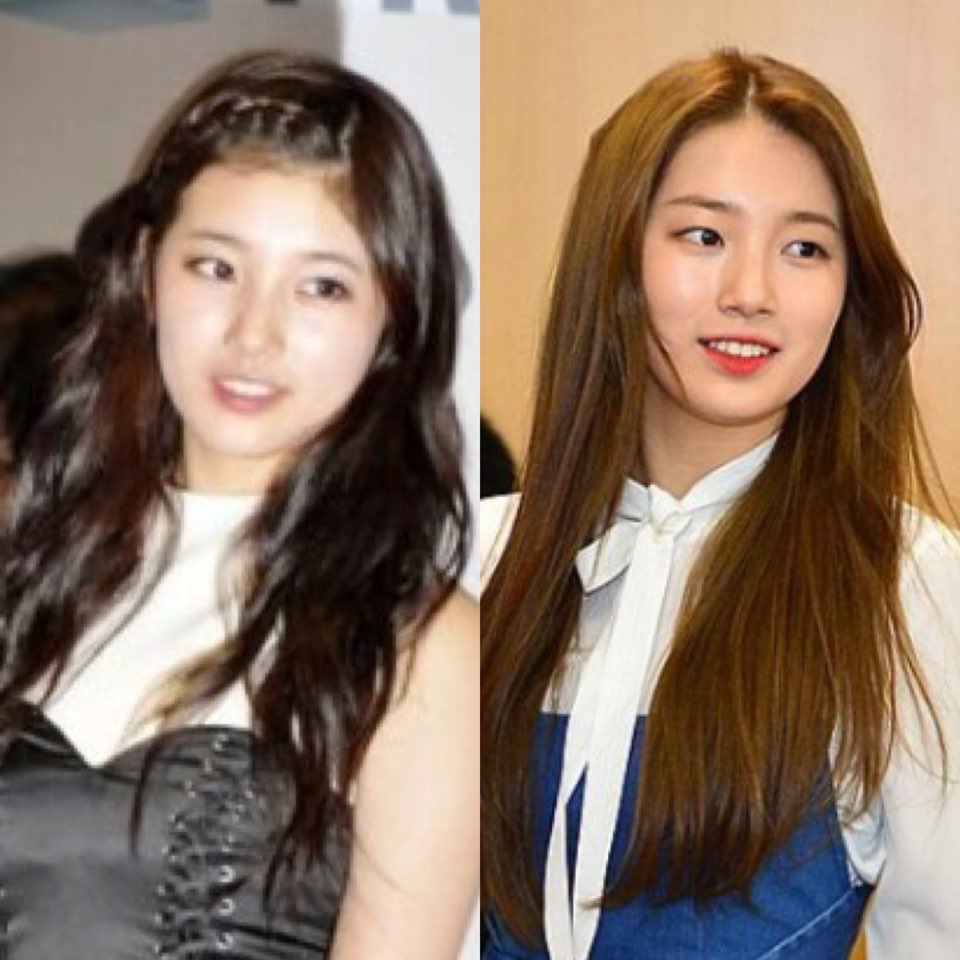
The length and width of the face, the position of the existing hairline, the transition between the central and side hairline, and the shape of the temples all need to be considered.
A natural hairline is also not a perfectly straight line.
At the very front of the hairline, finer and more delicate hairs can help create a softer transition.
Density can then gradually increase further behind the leading edge so that the transplanted area blends naturally with the existing hair.
Hair direction and angle are also important.
This is particularly noticeable around the temples and side hairline, where grafts placed at an unnatural direction or angle may look different from the surrounding hair.
For this reason, the outcome of a female hairline transplant cannot be judged simply by asking “How many grafts were transplanted?”
If your main concern is the shape of your hairline rather than overall thinning, see our guide on female hairline correction.
The number of grafts required can vary considerably from one person to another.
Even among women undergoing hair transplantation, the treatment area may be very different.
Someone who only wants to fill a small M-shaped area may require a different treatment plan from someone lowering the entire hairline.
Adding temple correction can increase the treatment area further, while restoring density around the part line or crown requires a different approach altogether.
The number of grafts can also vary depending on factors such as:
For this reason, graft numbers seen in another patient's before-and-after case should not automatically be applied to your own situation.
The expected treatment area and donor condition should be assessed together before estimating the number of grafts required.
Women can undergo either FUE or FUT hair transplantation depending on their donor condition, the number of grafts required and their individual preferences.
FUE (Follicular Unit Extraction) involves extracting individual follicular units from the donor area at the back of the scalp.
It avoids the long linear incision associated with FUT, but depending on the harvesting technique, part or all of the donor area may need to be trimmed short.
.png)
For women who are concerned about shaving the back of the head, other FUE harvesting approaches may also be available.
For example, only selected donor hairs may be trimmed, or a limited section underneath longer hair may be shortened so that the surrounding hair can help conceal the harvested area.
FUT (Follicular Unit Transplantation) involves removing a narrow strip of scalp from the donor area and separating it into individual follicular units for transplantation.
FUT can leave a linear scar at the donor site.
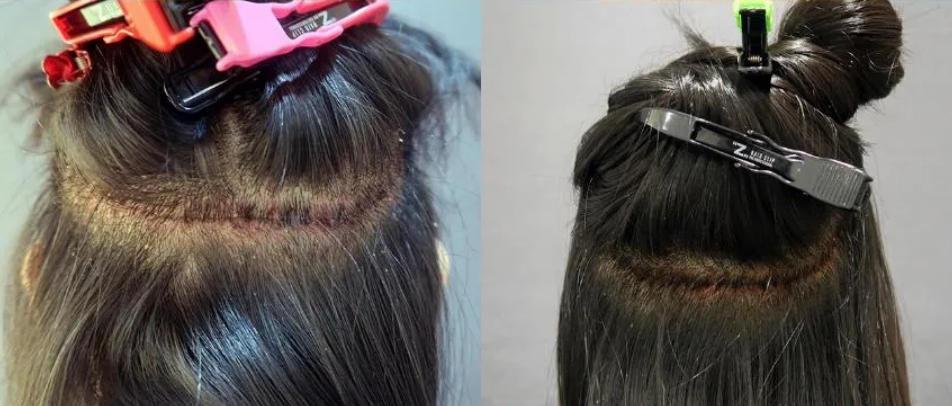
However, because the surrounding hair does not necessarily need to be widely shaved, women with longer hair may be able to conceal the donor area relatively easily after surgery.
For women with long hair in particular, the choice should therefore not be based simply on whether FUE or FUT is considered “better.”
The number of grafts required, donor condition, amount of shaving involved and usual hairstyle should all be considered when choosing the harvesting method.
For women in Singapore considering a hair transplant in Korea, the first step is to identify the main purpose of the procedure.
If the primary concern is a wide forehead, M-shaped hairline or sparse temples, hairline design and the area to be transplanted may be major considerations.
If the main concern is thinning around the part line or crown, however, the current pattern of hair loss and the condition of the donor area may need to be evaluated first.
In Korea, hair transplant clinics perform a wide range of procedures for women, including hairline correction, temple restoration and transplantation for areas affected by thinning. The approach to hairline design, harvesting method, estimated graft count and treatment plan can differ between clinics.
For this reason, it can be useful to compare more than the cost of a hair transplant in Singapore and Korea.
The proposed design, number of grafts, donor harvesting method and overall treatment plan should also be considered when deciding which option is suitable for you.
KAN HAIR works with partner hair transplant clinics in Korea and supports patients travelling from Singapore with clinic comparison, consultation and treatment planning, as well as preparation for their visit to Korea.
If you are considering a female hair transplant, photos of your current hairline, treatment area and donor area can be used as a starting point to estimate the potential treatment area and number of grafts required.
Considering a Hair Transplant in Korea from Singapore?
Send us your photos to get a personalised graft estimate and explore suitable treatment options in Korea.